10 Essential Insights into Python's deque for Real-Time Sliding Windows
If you've ever built a real-time data processing pipeline or implemented a sliding window algorithm in Python, you've likely encountered the performance bottleneck of using plain lists. Shifting elements, popping from the front, or resizing can grind your application to a halt. Enter collections.deque—the double-ended queue that powers high-performance sliding windows, thread-safe queues, and efficient data streams. In this listicle, we'll explore why lists fall short, how deque works, and eight more crucial insights to help you harness deque's full potential in your next project.
1. Why Lists Are Not Optimal for Sliding Windows
Python lists store elements in contiguous memory, which makes index-based access blazing fast. However, sliding windows require frequent removals from the left end and additions to the right. When you list.pop(0) or list.insert(0, item), every subsequent element must shift its position—an O(n) operation. For large lists or real-time streams, this overhead accumulates quickly, leading to performance degradation and unpredictable latency. Understanding this fundamental limitation is the first step toward adopting deque as a more efficient alternative.

2. Introducing collections.deque: The Double-Ended Queue
Deque (pronounced deck) is a container from Python's standard library that implements a double-ended queue. It is optimized for fast appends and pops from either end, achieving O(1) time complexity for both operations. Under the hood, deque uses a doubly-linked list of fixed-sized blocks, allowing it to grow and shrink efficiently. This design makes it ideal for scenarios where you need to maintain a sliding window while continuously adding and removing items on opposite sides. Its memory layout also avoids the fragmentation issues that can plague lists during frequent left-side modifications.
3. O(1) Appends and Pops from Both Ends
The hallmark feature of deque is its constant-time operations on both ends. deque.append(x) and deque.appendleft(x) add elements to the right and left, respectively, without any shifting. Similarly, deque.popleft() removes from the left and deque.pop() from the right—all in O(1). For sliding window algorithms, this means you can popleft() the outgoing element and append() the incoming one without paying the linear cost that a list would incur. This performance gain becomes especially pronounced when window sizes are large or when the stream runs for millions of steps.
4. Efficient Sliding Window with popleft() and append()
Consider a real-time metric that averages the last k data points. With a list, you'd need to update the sum by subtracting the outgoing element and adding the incoming, but you'd also have to manage the removal from the front. Using deque, you can simply popleft() the oldest value, append() the new one, and maintain the running sum. No element shifting, no extra memory copies. This pattern extends to any window-based computation—moving averages, smoothing filters, anomaly detection—and turns what would be an O(n) update into an O(1) one. The result is a smoother, faster algorithm that scales effortlessly with window size.
5. Thread-Safe Operations with deque (GIL)
In multithreaded applications, deque's append and pop methods are atomic due to Python's Global Interpreter Lock (GIL). This means you can safely use a single deque from multiple threads for lightweight producer-consumer patterns without additional locking mechanisms—as long as operations are confined to these O(1) methods. However, caution is needed: compound operations like checking if deque: before popping are not atomic. For such cases, you might still need a lock or consider queue.Queue. Nonetheless, for simple sliding windows shared between threads, deque provides a fast, thread-safe foundation.
6. Memory Efficiency Compared to Lists
Lists pre-allocate memory, which can lead to overallocation and wasted space when you frequently remove elements from the left. Deque, on the other hand, allocates memory in fixed-size blocks (typically 64 elements per block) and only adds blocks as needed. When you popleft() many items, blocks are freed and memory is returned to the pool. This memory discipline means deque often uses less overall memory than a list performing the same sliding window operation, especially over long durations. For applications with tight memory constraints—such as embedded systems or high-frequency trading—this efficiency is a critical advantage.
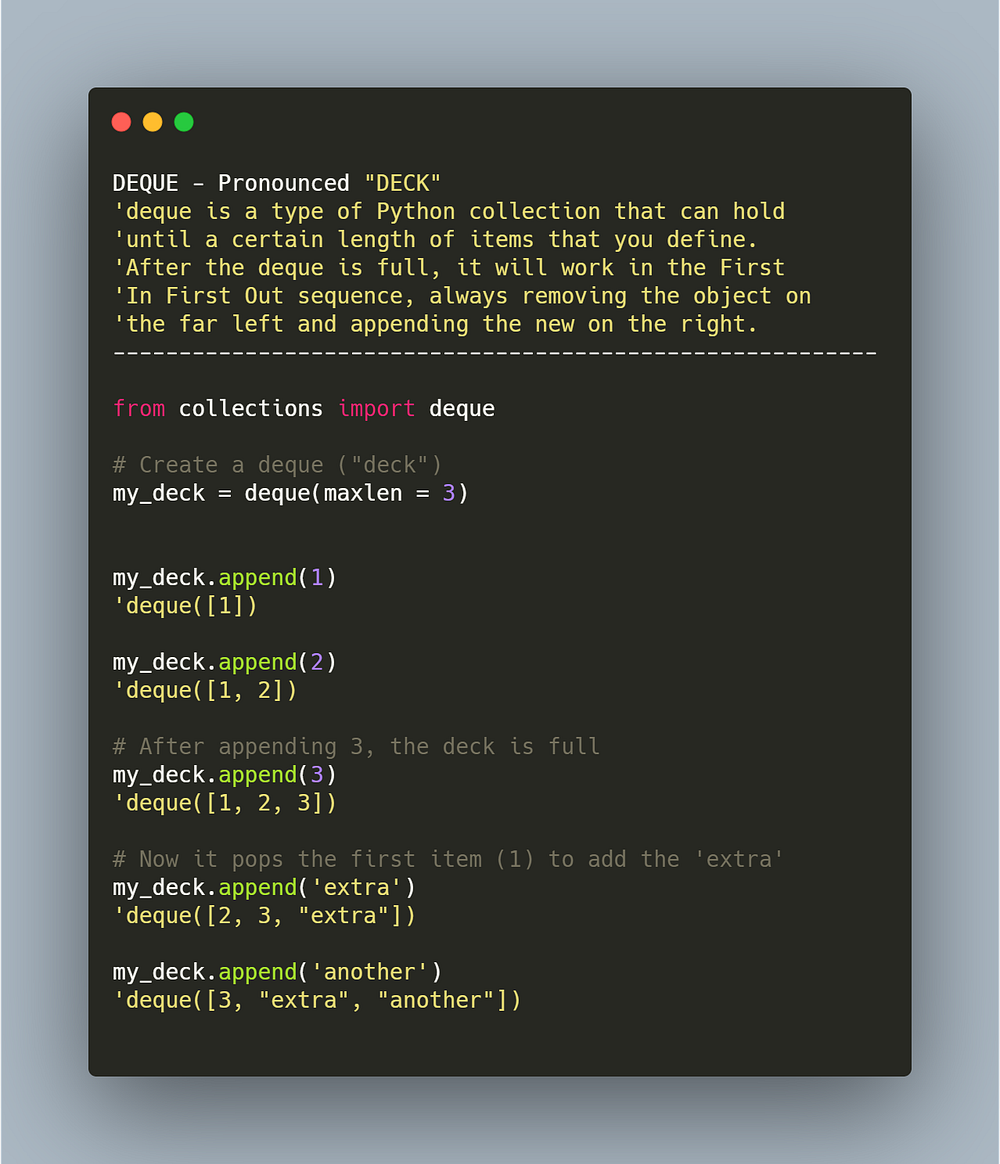
7. Using maxlen for Bounded Sliding Windows
Deque supports an optional maxlen parameter that automatically discards elements from the opposite end when the deque reaches its maximum length. For example, d = deque(maxlen=100) maintains exactly the last 100 items added. If you append() a 101st element, the leftmost element is automatically removed. This built-in behavior perfectly models a sliding window of fixed size. You no longer need to manually popleft(); the deque handles it for you. This makes code cleaner, more readable, and less error-prone, while still benefiting from O(1) performance on both ends.
8. Real-Time Data Streaming with deque
Real-time data streams—from sensor readings to log events—demand low-latency processing. Deque's O(1) operations ensure that each new data point can be inserted and the oldest one removed in constant time, regardless of window size. Combined with maxlen, you get a self-managing circular buffer ideal for streaming analytics. Whether you're computing running statistics, detecting anomalies, or implementing a real-time user interface, deque keeps your processing pipeline snappy and predictable. Its performance is reliable even under high-frequency updates, making it a go-to tool for time-series and event-stream applications.
9. Comparison with queue.Queue for Multithreading
Python's queue.Queue is designed for thread-safe communication between producers and consumers, but it comes with overhead: it uses locks and condition variables internally. deque, while thread-safe for individual operations, lacks the blocking behavior and fine-grained synchronization of Queue. For sliding windows that are only accessed by a single thread, deque is lighter and faster. For multi-producer/multi-consumer scenarios where you need blocking and timeout support, queue.Queue is more appropriate. Understanding this distinction helps you choose the right tool: deque for high-performance window processing, Queue for safe message passing.
10. Advanced Patterns: Rotating, Extending, and Slicing
Beyond sliding windows, deque offers powerful methods for advanced workflows. deque.rotate(n) shifts all elements right or left by n steps—useful for circular buffers or ring buffers. extend(iterable) and extendleft(iterable) add multiple elements in O(k) time. Slicing is not directly supported (deque provides no __getitem__ for slices), but you can convert to a list temporarily or iterate. For pattern matching in streaming data, you can combine rotate with append to implement efficient state machines. These capabilities extend deque's usefulness beyond simple windows into a versatile tool for any scenario requiring efficient queue operations.
In summary, Python's collections.deque is far more than a niche data structure—it's the backbone of high-performance sliding windows, thread-safe queues, and real-time data processing. By understanding its O(1) operations, memory efficiency, and built-in maxlen feature, you can replace error-prone list shifting with clean, fast code. Whether you're analyzing stock ticks, monitoring server logs, or building an online gaming leaderboard, deque will help you move beyond the limitations of lists and unlock true real-time performance.
Related Articles
- Python's Steep Learning Curve: New Findings Highlight Persistent Development Challenges
- Unlocking Blazing-Fast Data Transfers: Apache Arrow Integration in mssql-python
- How to Build a Real-Time Hallucination Shield for Your RAG Pipeline
- iPhone Push Notification Database Exposed Signal Messages Despite App Deletion, FBI Investigation Reveals
- Magento 2 Stores Under Siege: Database Deadlock Crisis Hits Peak Traffic
- Building a Multistage Multimodal Recommender on Amazon EKS: A Practical Guide
- Apache Arrow Integration in mssql-python: Accelerating Data Loading and Interoperability
- Mastering Queue Recovery: A Q&A on Backlog Capacity Planning