Nvidia and the Dawn of AI Factories: Why the Market Misreads the Shift to Accelerated Computing
Introduction
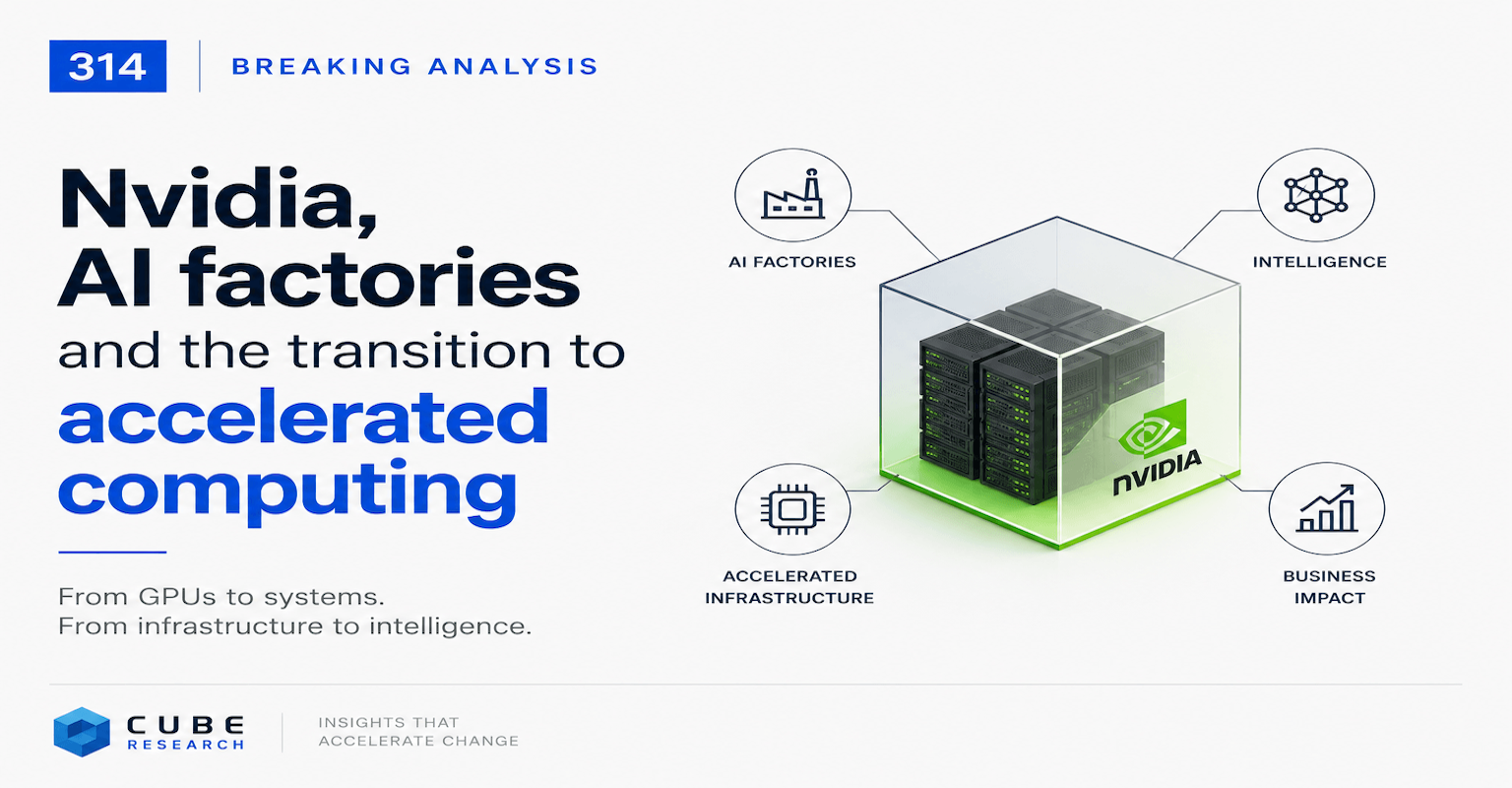
Nvidia Corp. has seen its market capitalization surpass the $5 trillion mark, prompting many analysts to question whether the valuation has run too far ahead of reality. Yet beneath this surface-level skepticism lies a deeper transformation that the broader market has yet to fully internalize: the transition to accelerated computing and the emergence of AI factories. This shift is not merely a technological upgrade; it resembles the historic RISC-to-x86 revolution in scale and significance. In this article, we explore what accelerated computing means, why AI factories are the next frontier, and why Nvidia is uniquely positioned to lead this transition – and why the market may be undervaluing its potential.
Understanding Accelerated Computing
Traditional computing relies on general-purpose CPUs that handle a wide variety of tasks sequentially. Accelerated computing, by contrast, uses specialized hardware – like graphics processing units (GPUs) – to perform many tasks in parallel, dramatically speeding up workloads such as deep learning, scientific simulations, and real-time data analytics. Nvidia’s CUDA platform has become the de facto standard for this kind of acceleration, enabling developers to harness GPU power for everything from AI training to high-performance computing.
The shift from scalar to accelerated computing is not just about faster chips. It fundamentally changes how data centers are designed and how workloads are processed. Instead of relying on thousands of general-purpose servers, modern AI factories use clusters of GPUs to process massive datasets in parallel, slashing training times from weeks to hours.
The Rise of AI Factories
An AI factory is a specialized data center designed entirely for artificial intelligence workloads. These facilities are equipped with thousands of Nvidia GPUs, connected via high-speed networks and optimized for distributed training and inference. Companies like Microsoft, Amazon, Google, and Meta are already building AI factories at scale, while startups and enterprises are increasingly leasing GPU capacity from cloud providers.
The demand for AI factories is driven by the explosive growth of generative AI, large language models, and autonomous systems. Training a model like GPT-4 requires tens of thousands of GPUs running for months – a level of compute that only a dedicated AI factory can provide. As AI becomes embedded in every industry, the need for such factories will only multiply, creating a multi-trillion-dollar market over the next decade.
Nvidia’s Strategic Position
Nvidia is not just a supplier of chips; it has built a comprehensive ecosystem that spans hardware, software, and networking. Its H100 and B200 GPUs are the gold standard for AI acceleration, and its CUDA software stack locks in developers and enterprises. Furthermore, Nvidia’s networking technologies like InfiniBand and Spectrum-X enable the massive scale required for AI factories. The company’s recent acquisition of Mellanox underscores its commitment to building end-to-end solutions.
This vertical integration gives Nvidia a formidable competitive moat. While rival companies develop competing chips, none offers the same level of performance, ecosystem breadth, or developer support. As a result, Nvidia captures an outsized share of the value created by the transition to accelerated computing.

Market Misperceptions and Valuation
Despite these advantages, some investors see Nvidia’s five-handle market cap as a sign of impending turbulence. They worry that growth must inevitably slow, competition will erode margins, or the AI hype cycle will deflate. However, such concerns overlook a crucial point: the market is trying to price a transition it hasn’t fully internalized.
In our view, the correct mental model is not a fixed-capacity market but a rapidly expanding one. The shift from general-purpose computing to accelerated computing represents a new layer of infrastructure, much like the move from mainframes to PCs or from on-premise servers to cloud computing. Each previous transition created multiples of value for the dominant players. We believe Nvidia’s potential is far larger than current price targets imply.
Historical Parallels: The RISC-to-x86 Transition
The closest historical analogy is the shift from RISC-based architectures to x86 in the 1990s. At the time, complex instruction set computing (CISC) via x86 was considered inefficient compared to reduced instruction set computing (RISC). Yet Intel and AMD proved that leveraging the x86 ecosystem – with its vast software compatibility and aggressive scaling – could outperform RISC in mainstream computing. That transition created decades of growth for Intel.
Today, the shift from scalar to accelerated computing is even more profound. “Though the shift underway resembles the RISC-to-x86 transition, it is far larger in scale and pace,” as industry observers note. Nvidia is to accelerated computing what Intel was to x86: the platform that defines the era. And just as Intel’s growth seemed unending in the 1990s, Nvidia’s trajectory may be similarly long-lived.
Conclusion
The market’s hesitation to embrace Nvidia’s valuation is understandable but likely misplaced. The transition to accelerated computing and the rise of AI factories are still in their early innings. As enterprises and cloud providers race to build out this new infrastructure, Nvidia’s ecosystem and market position will prove indispensable. Investors who recognize this shift early may benefit from a once-in-a-generation opportunity.
In summary, the five-handle market cap is not a ceiling but a floor – and the journey has only just begun.
Related Articles
- Kraken's Parent Company Files for National Trust Charter, Eyes Institutional Expansion
- SEC Proposes Repeal of Climate Risk Reporting Requirements: A Shift in Investor Protection
- AI Arms Race Drives Big Tech Capex to Record Highs: Amazon, Microsoft, Google Reveal Hundreds of Billions in Spending
- How Prediction Markets Are Betting on Hantavirus: A Step-by-Step Guide
- Docs.rs Streamlines Default Build Configurations: Fewer Targets, Faster Builds
- How to Swap Bitcoin for USDC Without Custody: A Step-by-Step Guide Using Boltz
- Is the 4% Retirement Rule Still Reliable for Future Retirees?
- How to Launch Bitcoin Banking Services with Galoy's All-in-One Platform