Mastering Kubernetes Secret Management: Why Vault Secrets Operator (VSO) is the Enterprise Standard
Platform teams managing Kubernetes often face a security gap when it comes to secret management at scale. Native Kubernetes Secrets lack the governance and lifecycle automation required for enterprise environments. HashiCorp Vault has emerged as the industry standard for centralized secret management, but multiple integration patterns with Kubernetes and OpenShift exist, each with its own tradeoffs. This Q&A demystifies these methods and explains why the Vault Secrets Operator (VSO) is now the recommended modern approach.
What are the limitations of native Kubernetes Secrets for enterprise environments?
Kubernetes offers native Secrets objects, but they are not designed to meet the rigorous governance, rotation, and auditing needs of an enterprise. These secrets are stored in etcd with base64 encoding, not true encryption by default. They lack fine-grained access control, versioning, and automated lifecycle management—such as dynamic secret generation, rotation, and revocation. As organizations scale across multiple clusters and clouds, manually managing secrets becomes error-prone and slow. Native Secrets also tie secrets tightly to the cluster, making it difficult to share the same secret across Kubernetes and non-Kubernetes workloads. Without a centralized policy engine, compliance and security audit trails are hard to maintain. These gaps force enterprises to look beyond native Kubernetes Secrets for a robust, platform-agnostic solution.
Why is HashiCorp Vault the preferred choice for centralized secret management?
HashiCorp Vault is widely adopted as the enterprise standard for centralized secrets management because it provides a unified way to store, access, and rotate secrets across diverse environments. It supports dynamic secrets (e.g., database credentials, cloud API keys) that are generated on-demand with TTL, reducing the risk of long-lived static secrets. Vault offers strong encryption, detailed audit logs, and policy-based access control, meeting strict compliance requirements. Its identity-based approach allows secrets to be tied to application identities (e.g., Kubernetes service accounts) rather than static files. Vault also integrates seamlessly with cloud providers, databases, and CI/CD pipelines. For Kubernetes and OpenShift, Vault enables consistent secret delivery while preserving the security and lifecycle automation that native Kubernetes Secrets lack.
What are the different methods to integrate Vault with Kubernetes and OpenShift?
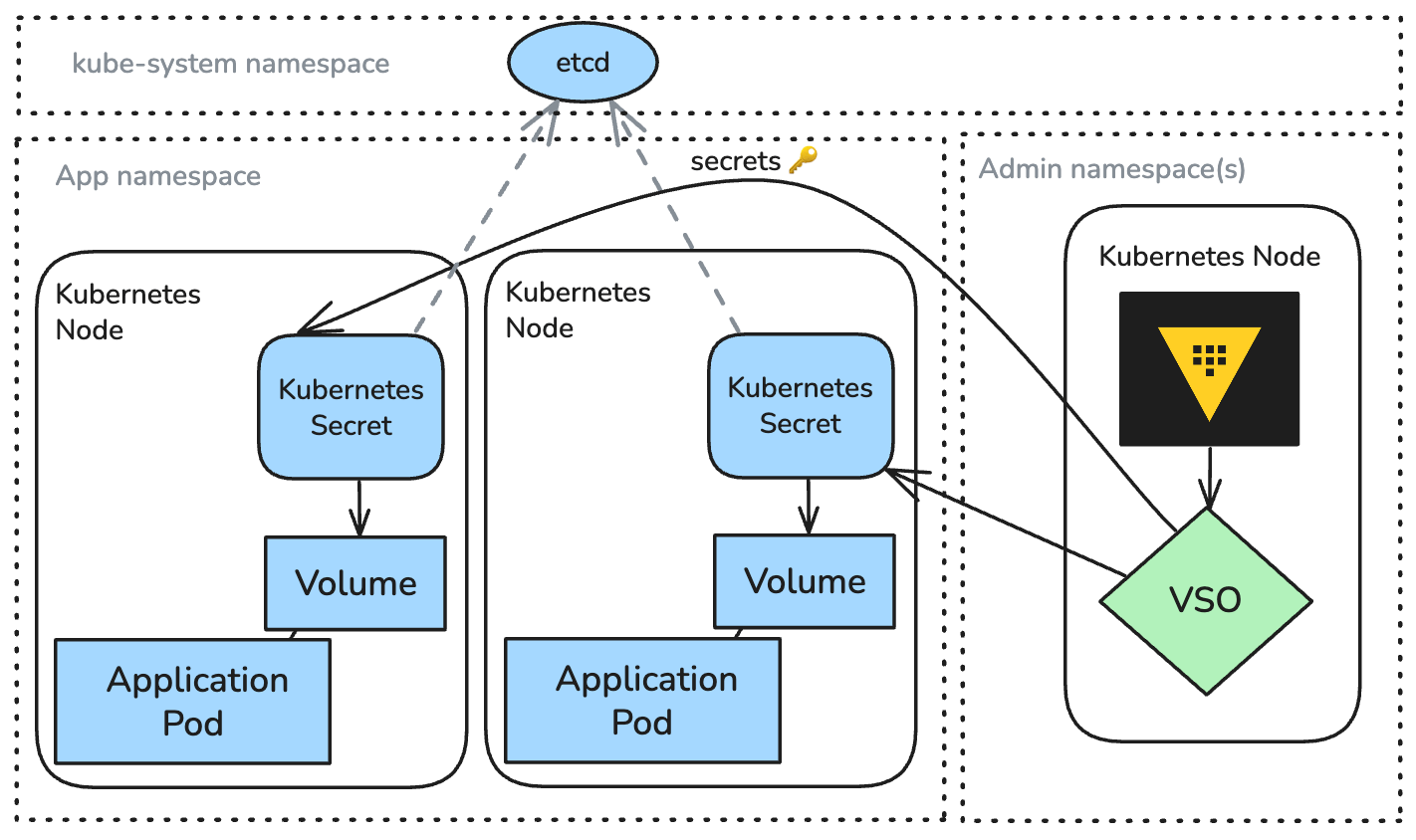
Several integration patterns exist, each with distinct operational and security tradeoffs. Historically, the Vault Agent Sidecar Injector was the first robust solution, injecting a Vault agent sidecar into pods to fetch and renew secrets. The Secrets Store CSI Driver (SSCSI) allows pods to mount secrets as volumes from external stores like Vault. Third-party operators, such as External Secrets Operator, also provide alternatives. The most modern and recommended approach is the Vault Secrets Operator (VSO), which is a Kubernetes-native operator that reconciles custom resources (e.g., VaultStaticSecret, VaultDynamicSecret) to fetch and sync secrets from Vault into Kubernetes Secrets or directly into pods via a built-in CSI companion driver. VSO aligns with Kubernetes declarative patterns and reduces operational overhead.
How does the Vault Secrets Operator (VSO) improve upon previous integration patterns?
The Vault Secrets Operator (VSO) is a joint effort between HashiCorp and Red Hat (IBM) to provide a fully Kubernetes-native secret lifecycle automation solution. Unlike the sidecar injector, which requires modifying pod specs and running an additional sidecar container, VSO operates at the cluster level, managing secrets declaratively through Custom Resource Definitions (CRDs). This means platform teams can define secret consumption policies centrally, and secrets are synced as Kubernetes Secrets without changing how applications interact with them. VSO also includes a built-in CSI driver for direct volume mounting, offering flexibility. It supports dynamic secrets, rotation, and revocation natively. By leveraging Kubernetes controllers, VSO ensures that secrets are updated automatically when they change in Vault, eliminating the need for custom scripts or manual intervention.
What are the tradeoffs between VSO and the Vault Agent Sidecar Injector?
The Vault Agent Sidecar Injector was an early solution that works well for single-pod contexts but introduces several tradeoffs. It requires an additional sidecar container per pod, increasing resource usage and startup time. The sidecar must be configured with Vault connection details, and pods need mutation webhooks, which can complicate security postures. Sidecars also lack native support for dynamic secrets rotation without restarting the pod. In contrast, VSO operates at the operator level, reducing resource overhead and providing a cleaner separation of concerns. However, VSO syncs secrets into Kubernetes Secrets, which may not meet all compliance requirements (e.g., encryption at rest in etcd). The built-in CSI driver addresses this by mounting secrets directly without storing them in etcd. VSO also requires CRDs and RBAC setup, which may be more complex to start with but scales better.
Why is VSO considered the recommended standard for most organizations today?
VSO has become the recommended standard because it aligns with Kubernetes best practices: declarative configuration, operator pattern, and minimal application changes. It simplifies secret lifecycle management by automating synchronization, rotation, and revocation without modifying pod specifications. The partnership between HashiCorp and Red Hat through IBM ensures deep integration with OpenShift and enterprise support. VSO supports both static and dynamic secrets, and its built-in CSI driver offers a zero-footprint option for security-sensitive workloads. It reduces the operational burden on platform teams by centralizing secret policies and providing audit trails. For organizations scaling across clusters and clouds, VSO provides a consistent, secure, and developer-friendly way to deliver secrets, making it the go-to choice for modern Kubernetes secret management.
Related Articles
- Checkmarx Jenkins Plugin Compromised in New TeamPCP Supply Chain Attack
- Stable Kernel Releases: What You Need to Know About the Latest Updates
- China-Linked Cyber Espionage Group Targets Asian Governments and NATO Ally
- Cisco Urges Immediate Patching for Critical SD-WAN Controller Zero-Day Exploit
- Automate Exposure Validation to Outpace AI-Driven Attacks: A Step-by-Step Guide
- Giant Squid Revealed: DNA Traces in Western Australian Waters
- The Fall of a Cyber Thief: 10 Key Facts About the 'Scattered Spider' Member Who Pleaded Guilty
- Learning from Two Decades of Cybersecurity Catastrophes: A Guide to Avoiding the Same Mistakes