Unlocking LLM Efficiency: TurboQuant and KV Cache Compression Explained
Retrieval-Augmented Generation (RAG) systems and large language models (LLMs) rely heavily on efficient memory management to scale effectively. One of the most critical bottlenecks is the key-value (KV) cache, which stores intermediate computations during inference. Google's recent launch of TurboQuant offers a groundbreaking solution for compressing these caches without sacrificing performance. This Q&A explores how TurboQuant achieves effective KV compression, its role in RAG, and its impact on LLM deployment.
1. What is TurboQuant and how does it improve KV cache compression in LLMs?
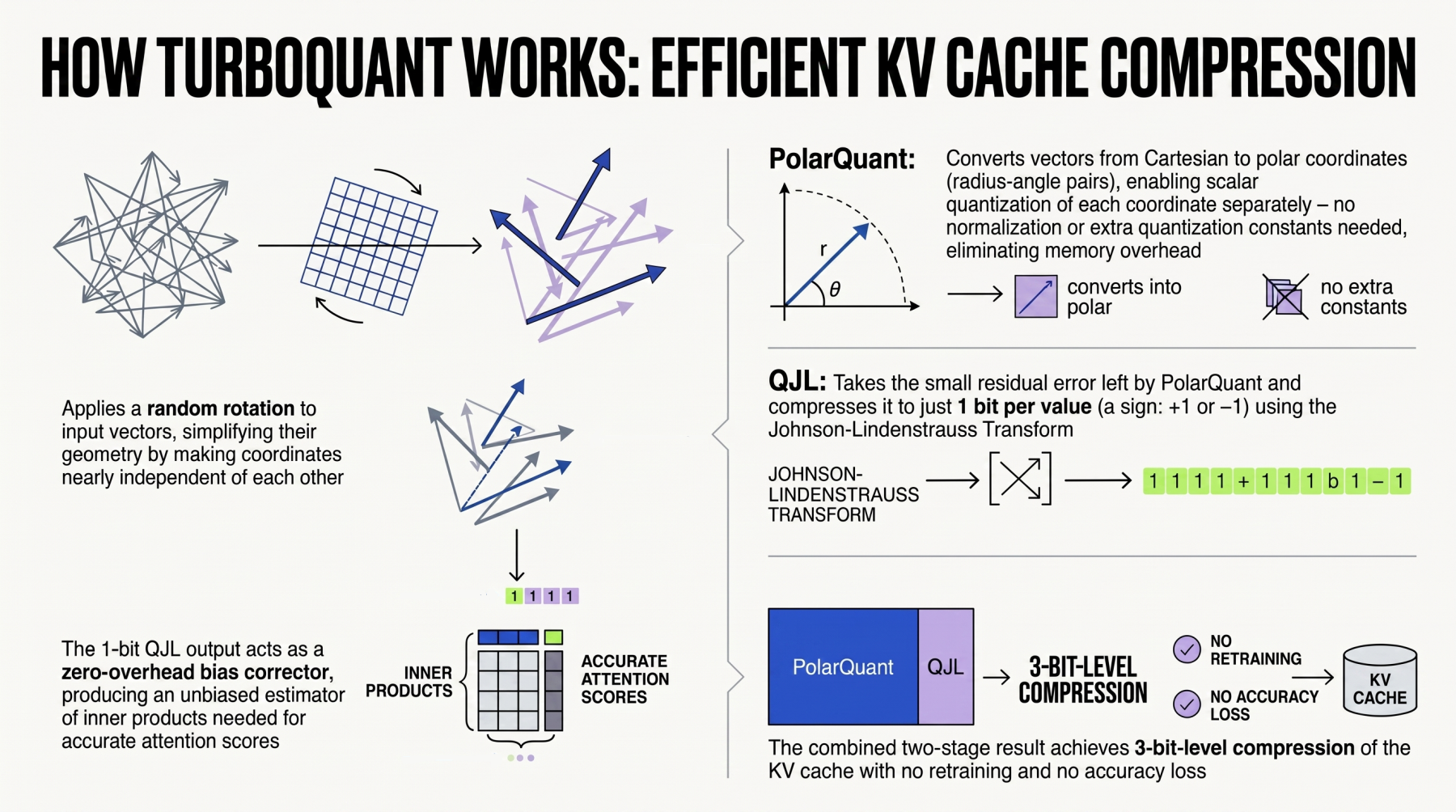
TurboQuant is an algorithmic suite and software library developed by Google that applies advanced quantization and compression techniques specifically to the key-value (KV) caches used in large language models (LLMs). The KV cache stores intermediate attention computations during auto-regressive generation, which can grow extremely large as context length increases. TurboQuant reduces this memory footprint by representing KV entries with fewer bits—using quantization methods that are carefully calibrated to preserve model accuracy. Unlike simple post-training quantization, TurboQuant employs novel algorithms that adapt to the unique statistical properties of KV caches, achieving higher compression ratios (e.g., 4-bit or even 2-bit) while maintaining output quality. This directly accelerates inference speed and reduces hardware costs, making LLMs more feasible for real-time applications like chatbots and search engines.
2. Why is KV cache compression important for large language models?
KV cache compression is crucial because the memory demands of LLMs scale quadratically with sequence length during inference. For every new token generated, the model must attend to all previous tokens, requiring the KV cache to store every key and value vector from earlier attention layers. As context windows grow to 32K, 128K, or even 1M tokens, the cache can consume dozens of gigabytes of GPU memory per request. Without compression, serving long-context LLMs becomes prohibitively expensive and slow. Compressing the KV cache with TurboQuant reduces memory consumption dramatically, enabling longer context windows on existing hardware, lower latency per token, and higher throughput for batch processing. It also improves cost-efficiency for cloud deployments and allows edge devices to run large models more feasibly.
3. How does TurboQuant's algorithmic approach differ from standard quantization methods?
Standard quantization methods, such as uniform quantization or simple min-max scaling, often fail to preserve the precision of KV caches because these caches exhibit high variance and non-uniform distributions. TurboQuant uses a suite of advanced algorithms that include groupwise quantization with learnable scales, outlier-aware clipping, and iterative calibration to minimize information loss. Specifically, it groups KV vectors together and applies separate quantization parameters per group, capturing local variations. It also identifies and handles outlier values—those far from the mean—by using special encoding or higher precision for those dimensions. Additionally, TurboQuant incorporates a calibration process that uses a small dataset to optimize quantization thresholds, ensuring that the compressed cache behaves as closely as possible to the original floating-point version. These techniques yield higher compression ratios (even below 4 bits) with negligible accuracy degradation.
4. What role does TurboQuant play in RAG (Retrieval-Augmented Generation) systems?
RAG systems combine a vector search engine (for retrieving relevant documents) with an LLM to generate answers grounded in external knowledge. The vector search engine typically stores embeddings of documents and performs approximate nearest neighbor search. TurboQuant enhances RAG by compressing both the vector embeddings stored in the search index and the KV cache generated during the LLM inference stage. For the vector index, TurboQuant's quantization reduces memory for storing millions or billions of vectors, allowing faster search and lower operational costs. For the LLM's KV cache, compression enables the model to ingest longer retrieved contexts without running out of memory. Together, these optimizations enable RAG pipelines to handle larger document corpuses, longer contexts, and more user queries in real time, making them more scalable and cost-effective for enterprise applications.
5. Can TurboQuant be integrated with existing LLM frameworks and open-source models?
Yes, TurboQuant is designed as a flexible library that can be integrated with popular LLM frameworks like TensorFlow, PyTorch, and JAX, as well as inference engines such as TensorRT and ONNX Runtime. Google has released TurboQuant as open-source (or as part of its research repositories) so that developers can apply its compression algorithms to both Google's own models (like Gemma, PaLM, or Gemini) and widely used open-source models (LLaMA, Mistral, Falcon). The library provides APIs to insert quantization hooks into the attention layers, calibrate the KV cache using a few sample sequences, and then convert the model to a compressed version. It also supports export to formats compatible with vector search libraries like ScaNN or FAISS. This makes adoption straightforward for teams already using standard LLM tooling.
6. What are the key benefits of using TurboQuant for vector search engines?
Vector search engines are essential for RAG and similarity-based retrieval, but they face scalability challenges as the number of indexed vectors grows into the billions. TurboQuant brings several benefits: first, it reduces the storage footprint of each vector by quantizing from 32-bit floating point to 4-bit or even 2-bit representations, cutting memory usage by up to 8×. This allows larger indexes to fit on a single machine or reduces cloud storage costs. Second, lower precision vectors lead to faster distance computations (e.g., using integer arithmetic), which accelerates search latency. Third, TurboQuant's calibration ensures minimal recall loss—often less than 1% drop in retrieval accuracy. Finally, because it works seamlessly with existing approximate nearest neighbor (ANN) algorithms, users can upgrade their search engines without redesigning the entire pipeline. These benefits translate directly into more responsive and affordable RAG systems.
7. How does TurboQuant ensure minimal loss of accuracy while achieving high compression ratios?
TurboQuant employs a combination of calibration-aware quantization and mixed-precision strategies to maintain accuracy. Before quantization, the tool profiles the KV cache (or vector embeddings) using a small validation dataset to understand the distribution of values. It then applies sensitivity analysis to determine which dimensions or groups contribute most to output quality—those receive higher precision (e.g., 8 bits) while less sensitive ones are compressed more aggressively (4 or 2 bits). Additionally, TurboQuant uses per-channel quantization and dynamic scales that adjust based on the input, rather than using fixed global parameters. An iterative fine-tuning step (optional) can further recover any lost accuracy by adjusting the quantized weights using a loss function that mimics the original model's behavior. Rigorous benchmarks on standard LLM tasks show that even at 2-bit compression, the perplexity increase is under 0.1, and the performance on downstream tasks like question answering remains within 1% of the full-precision baseline.
Related Articles
- Beyond the Wi-Fi Signal: The Hidden Infrastructure Powering Remote Work
- 9 Game-Changing AWS Announcements from What's Next 2026
- Containerizing a Go Application with Docker: A Comprehensive Guide
- Master macOS App Development: Your Comprehensive Q&A Guide
- Unlocking Apple Watch Educational Discounts: A Step-by-Step Guide for Students and Educators
- Theory vs. Practice: How Self-Hosting Transformed My Server Knowledge
- The Ever-Changing Web: A Design History from Tables to Standards
- Medical Education Under the Microscope: What Future Doctors Really Think About Nutrition and Preventive Care